

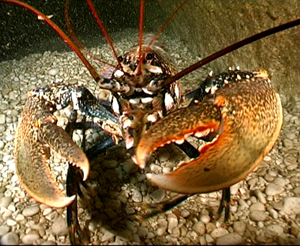
Phylum: Arthropoda Lar, 1904
Subphylum: CrustaceaBrünnich, 1772
Classe: Malacostraca Latreille, 1802
Ordine: Decapoda Latreille, 1802
Famiglia: Nephropidae Dana, 1852
Genere: Homarus Weber, 1795
Italiano: Astice europeo
English: European lobster, Common lobster
Français: Homard européen
Deutsch: Europäischer Hummer
Español: Bogavante
Descrizione
È molto simile all'astice americano (Homarus americanus). Di colore bluastro, con chiazze gialle sul dorso e ventre chiaro, possiede due paia di antenne, un paio lunghe ed uno corte e due chele, una più grande ed una più piccola, per poter svolgere meglio compiti diversi. Il carapace è liscio ed incavato, possiede due spine, situate vicino agli occhi. Può raggiungere il mezzo metro di lunghezza, ma gli esemplari comuni misurano dai 30 ai 40 cm. Meno pescato di quello americano, il sapore dell'astice europeo è ritenuto migliore. La maggior parte della pesca viene effettuata nel suo habitat naturale, spesso usando le apposite nasse per crostacei ed usando come esca del solo pesce, come ad esempio pezzi di polpo o di seppia. I tentativi di creare allevamenti di questo crostaceo non sono andati a buon fine a causa delle sue aggressive abitudini territoriali.
Diffusione
L'astice è presente nelle zone orientali dell'Oceano Atlantico, dalla Norvegia nord-occidentale fino alle Azzorre e al Marocco. Si trova anche nel Mar Mediterraneo ad ovest di Creta ed a nord-ovest del Mar Nero, ma non nel Mar Baltico. Questo crostaceo vive attaccato alle rocce sottomarine, raramente sotto i 50 m, ma fino ad un massimo di 150.
Sinonimi
= Cancer gammarus (Linnaeus, 1758) = Astacus marinus (Fabricius, 1775) = Astacus gammarus (Pennant, 1777) = Homarus marinus (Weber, 1795) = Astacus europaeus (Couch, 1837) = Homarus vulgaris (H. Milne Edwards, 1837).
Bibliografia
–Butler, M.; Cockcroft, A.; MacDiarmid, A.; Wahle, R. (2011). "Homarus gammarus". IUCN Red List of Threatened Species. 2011.
–Holthuis, Lipke B. (1991). "Homarus gammarus". FAO Species Catalogue, Volume 13: Marine Lobsters of the World. FAO Fisheries Synopsis No. 125. Food and Agriculture Organization. p. 60.
–"European lobster: notes on the sizes of Homarus gammarus". British Marine Life Study Society. Retrieved October 14, 2010.
–Beard, T. W.; McGregor, D. (2004). "Store and care of live lobsters" (PDF). Laboratory Leaflet Number 66 (Revised). Lowestoft: Centre for Environment, Fisheries and Aquaculture Science.
–"Orange lobster with two sharp claws is one in a million (or more)". National Marine Aquarium.
–P. J. Hayward; M. J. Isaac; P. Makings; J. Mayse; E. Naylor; G. Smaldon (1995). "Crustaceans (Phylum Crustacea)". In P. J. Hayward; John Stanley Ryland (eds.). Handbook of the marine fauna of north-west Europe. Oxford University Press. pp. 289-461.
–Davidson, Alan (2004). "Lobster (both European and American)". North Atlantic Seafood: A Comprehensive Guide with Recipes. Ten Speed Press. pp. 188-189.
–Hansen, P.; Aagaard, J. (2008). "Freezing of Shellfish". In Rudolf Kreuzer (ed.). Freezing and Irradiation of Fish. Read Books. pp. 147-158.
–Hauge, Marie (May 2010). "Unique lobster hybrid". Norwegian Institute of Marine Research.
–"Biology of the European lobster, Homarus gammarus". UK National Lobster Hatchery.
–Ann-Lisbeth Agnalt; Eva Farestveit; Kaare Gundersen; Knut E. Jørstad; Tore S. Kristiansen (2009). "Population characteristics of the world's northernmost stocks of European lobster (Homarus gammarus) in Tysfjord and Nordfolda, northern Norway". New Zealand Journal of Marine and Freshwater Research. 43 (1): 47-57.
–P. A. Prodöhl; K. E. Jørstad; A. Triantafyllidis; V. Katsares; C. Triantaphyllidis. "European lobster Homarus gammarus" (PDF). Genetic Impact of Aquaculture Activities on Native Populations. Norwegian Institute of Marine Research. pp. 91-98.
–A. Triantafyllidis; A. P. Apostolidis; V. Katsares; E. Kelly; J. Mercer; M. Hughes; K. E. Jørstad; A. Tsolou; R. Hynes; C. Triantaphyllidis (2005). "Mitochondrial DNA variation in the European lobster (Homarus gammarus) throughout the range". Marine Biology. 146 (2): 223-235.
–G. J. Inglis; B. J. Hayden; W. A. Nelson (2006). "Are the marine biotas of island ecosystems more vulnerable to invasion?". In Rob Allen; William George Lee (eds.). Biological Invasions in New Zealand. Volume 186 of Ecological studies. Springer Verlag. pp. 119-135.
–Baker, Jessica M.; Giribet, Gonzalo (2007). "A molecular phylogenetic approach to the phylum Cycliophora provides further evidence for cryptic speciation in Symbion americanus". Zoologica Scripta. 36 (4): 353-359.
–Bishop Percy's Folio Manuscript: loose and humorous songs ed. Frederick J. Furnivall. London, 1868.
–Davidson, Alan (2002). "Lobster". Mediterranean Seafood: A Comprehensive Guide with Recipes (3rd ed.). Ten Speed Press. p. 178.
–Sara Barrento; António Marques; Bárbara Teixeira; Paulo Vaz-Pires; Maria Leonor Nunes (2009). "Nutritional quality of the edible tissues of European lobster Homarus gammarus and American lobster Homarus americanus". Journal of Agricultural and Food Chemistry. 57 (9): 3645-3652.
–"Fishery Statistical Collections. Global Production". Fisheries Global Information System. Food and Agriculture Organization.
–"Minimum fish sizes" (PDF). Department for Environment, Food and Rural Affairs. Archived from the original (PDF) on November 6, 2009.
–"The Lobsters and Crawfish (Prohibition of Fishing and Landing) Order 2000". Crown Copyright 2000.
–Boxshall, Geoff (2007). "Crustacean classification: on-going controversies and unresolved problems" (PDF). In Z.-Q. Zhang; W. A. Shear (eds.). Linnaeus Tercentenary: Progress in Invertebrate Taxonomy. pp. 313-325.
–"Official Lists and Indexes of Names in Zoology" (PDF). International Commission on Zoological Nomenclature. March 31, 2010.
–Hemming, Francis (1955). "Proposed adoption of a 'Declaration' clarifying Rule (g) in Article 30 in relation to the selection of the type species of a genus in a case where the nominal species so selected, though not itself cited at the time of the establishment of the genus in question, is objectively identical with another nominal species which was so cited". Bulletin of Zoological Nomenclature. 11 (3): 86-89.
–"Common lobster (Homarus gammarus)". ARKive.
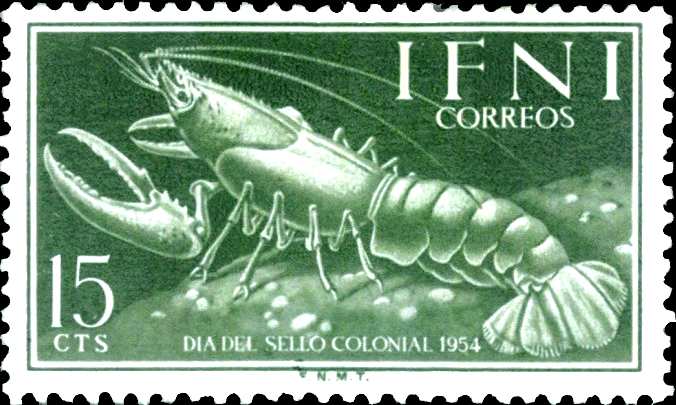
|
Data: 23/11/1954
Emissione: Vita nel mare Stato: Ifni Nota: Enmesso in una serie di 2 v. per 2 |
|---|
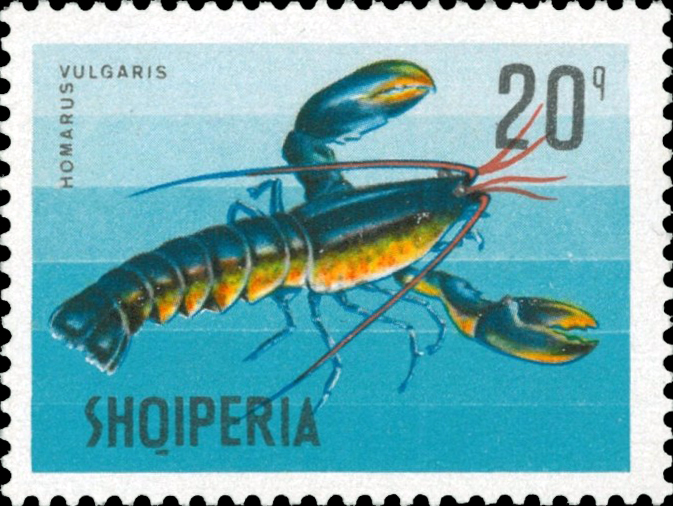
|
Data: 20/08/1968
Emissione: Vita marina Stato: Albania Nota: Emesso in una serie di 7 v. diversi |
|---|
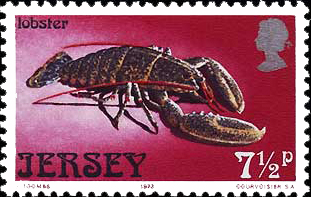
|
Data: 15/11/1973
Emissione: Vita nel mare Stato: Jersey Nota: Emesso in una serie di 4 v. diversi |
|---|
|
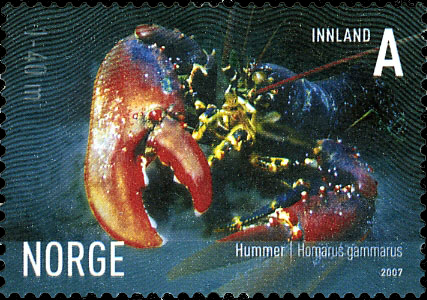
Stato: Norway |
|---|
|
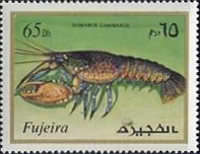
Data: 01/01/1972
Emissione: Vita marina Stato: Fujairah Nota: Emesso in una serie di 20 v. diversi |
|---|

|
Data: 10/09/1999
Emissione: Crostacei Stato: Korea (North) |
|---|

|
Data: 20/12/2011
Emissione: I frutti del mare Stato: Central African Republic Nota: Emesso in un foglietto di 4 v. diversi |
|---|

|
Data: 20/12/2011
Emissione: I frutti del mare Stato: Central African Republic Nota: Emesso in un foglietto di 4 v. diversi |
|---|

|
Data: 20/12/2011
Emissione: I frutti del mare Stato: Central African Republic Nota: Emesso in un foglietto di 4 v. diversi |
|---|

|
Data: 20/12/2011
Emissione: I frutti del mare Stato: Central African Republic Nota: Emesso in un foglietto di 4 v. diversi |
|---|

|
Data: 20/12/2011
Emissione: I frutti del mare Stato: Central African Republic |
|---|

|
Data: 13/09/2010
Emissione: Autumn - Wildlife Stato: Finland Nota: Autoadesivo Emesso in un foglietto di 3 v. diversi |
|---|

|
Data: 30/09/2022
Emissione: Crostacei Stato: Liberia |
|---|